Showing posts with label History Places. Show all posts

Thursday, January 19, 2017

Bani Waqif Fort Historic Place in Madinah

THE Bani Waqif Fort located 500 meters southeast of Quba Mosque is one of the historic landmarks in Madinah. It’s just four kilometers away from the Prophet’s Mosque and could be developed into a park and a tourist site.

Residents of Quba district of Madinah have accused the authorities of negligence toward the historic fort where the Prophet Muhammad, peace be upon him, had once prayed.

“The fort does not have a proper access road nor any signboard for people to locate the place,” said Nasser Al-Ahmadi, who urged the authorities to take immediate measures to rehabilitate the structure.

Researcher Mohammed Ghali Al-Tarjumi said Bani Waqif belonged to the famous Aus tribe, which provided all assistance when the Prophet migrated to Madinah.

“The Prophet Muhammad (pbuh) had prayed in their fort, which is located south of the Quba Mosque,” Al-Tarjumi told Okaz/Saudi Gazette.

The fort is located between houses and farms in Asba district. “It underwent renovation during the time of the Ottomans, who used it as a military garrison,” he said.

Al-Tarjumi said a number of historians have mentioned the fort in their works, including Al-Abbasi and Al-Samhoudi. “At present the fort is neglected and illiterate people have been causing harm to the fort over the past years exploiting the absence of monitoring,” he explained.

He said some people were throwing construction waste in the fort.

“There are several forts in Madinah. Bani Waqif Fort has one of the best and beautiful parks in the region with enchanting date palms and other trees. Standing on this fort, visitors can watch the famous Eir mountain in Madinah,” he added.
Bani Waqif Fort Historic Place in Madinah

Meanwhile, the head of the department of public relations and information at SCTH said the organization has registered Bani Waqif Fort as one of the national heritage sites.

“We intend to preserve this place with the support of an expert team as part of SCTH’s efforts to preserve and develop all Islamic heritage sites in the Madinah region,” he said in a statement. Bani Waqif Fort Historic Place in Madinah

Sunday, December 4, 2016

Quba First Mosque Built by Muslims

Quba Mosque was the first mosque to be built by Muslims. The Prophet himself laid the foundation stone of the mosque and laid its first tiles and his Companions completed it.

Quba was originally a well surrounded by a village. It was inhabited by the Bani Amr tribe. On his way to Madinah, the Prophet stayed at the home of Bani Amr Bin Auf and built a mosque in the area, which he named Quba.

Historical references indicate that the Prophet and his Companions (may Allah be pleased with them) built the mosque in the first year of Hijrah.

The mosque stands out along the Hijrah Road that links Makkah and Madinah. Located about 3.5 km south of the Prophet’s Mosque, the mosque can be seen from quite a distance.

The mosque witnesses an influx of worshippers throughout the year, but the numbers increase in Ramadan.

The Prophet used to visit Quba quite often to pray at the mosque, especially on Saturdays. It is described in the Holy Qur’an as the first mosque founded on piety.

According to a saying of the Prophet, whoever makes ablution at his home, travel to Quba Mosque and pray will receive a reward equal to performing one Umrah.

The Saudi government has given special care to this mosque and reconstructed it in the best form following Islamic architectural designs, considering its stature and position in the minds of Muslims around the world. It is currently the second largest mosque in Madinah after the Prophet’s Mosque.

The first renovation of the mosque took place during the time of Caliph Othman. Later, Caliph Omar Bin Abdul Aziz added a corridor and a minaret to the mosque. It was the first minaret for any mosque in the history of Islam.

In 435 AH (1043 AD), Abu Yaala Al-Hussaini and in 555 AH (1160 AD) Jamaluddin Al-Esfahani renovated the mosque. It was Al-Husaini who constructed a prayer niche known as the “mihrab” in the mosque.

Quba witnessed several successive renovations between the years 671 and 881 AH (1272-1476 AD), all carried out by philanthropists. During the Ottoman period, it was reconstructed several times, the last of which was during the rule of Sultan Abdul Majeed in 1245 AH (1829 AD).

During the Saudi era, Quba’s outside walls were renovated in 1388 AH (1968 AD).

In 1405 AH (1984 AD) King Fahd ordered a massive project to reconstruct the mosque completely, doubling its area. The king inaugurated the opening of the mosque after its expansion two years later.

The modern Quba Mosque is an architectural feat equipped with the latest amenities while maintaining its Islamic character. The mosque has been expanded to accommodate more than 20,000 worshipers.

The mosque was designed with an inner courtyard with several entrances. The northern section is reserved for women worshippers.

In order to preserve the precious heritage, parts of the old mosque was added to the new structure.

The new mosque has four minarets with a height of 47 meters as well as six large domes with a radius of 12 meters each and 56 smaller domes. Its floor is paved with high quality marble while its courtyards have been covered with sunshades to protect worshippers from the sweltering sun.

The Ministry of Haj and Umrah has deployed additional staff at Quba Mosque to provide various services to worshippers during Ramadan.

THOUSANDS of Muslims, from local worshippers to foreign pilgrims, gather at the Quba Mosque to break their fast and take part in Maghreb, Isha and Taraweeh prayers during Ramadan.

Quba Mosque is the first ever mosque built in Islam. It is located in the southwest of Al-Madinah city. When the Messenger of Allah, (peace be upon him), arrived to Quba, he stayed at Beni Amr Ibn Awf and established the first mosque there. Holy Prophet built it himself with his hands. Even after he left to Al-Madinah he used to visit Quba and pray in the mosque. This he did until his death. Then, his companions continued to do the same. The mosaque had a well for Abi Ye’qob AL-Ansari. Expansions to the mosque have been made during the early Islamic periods.  The final expansion was on the latest architectural styles during the reign of King Fahd bin Abdul Aziz, (may Allah merciful to him).

Quba First Mosque Built by Muslims
Quba — the first mosque in the history of Islam

Quba Mosque to the south of Madinah is the second largest and prestigious mosque in the city after the Prophet’s Mosque, but claims the first place owing to its importance in Islamic history having been built in the first year of the Islamic calendar.

The mosque contained a well which belonged to Abu Ayyub Al-Ansari (may Allah be pleased with him). It became a blessed place as the Prophet’s she-camel first knelt down there to take a long draught of water after the Prophet’s journey. 

The prestigious and unique characteristics of Quba Mosque compared to other mosques are cited in this Hadith narrated by the Prophet (peace be upon him): “Whoever makes ablutions in this house and offers one prayer therein, will be rewarded the equivalent of one Umrah.”

The Prophet (peace be upon him) made it a habit to come to Quba Mosque every Saturday, either riding his camel or on foot and offer two rak’at prayers.

“The Prophet (peace be upon him) used to go to Quba Mosque sometimes walking, sometimes riding,” narrated by Ibn Umar, and in another narration: “He would then offer two Rak’at”. ‘Abdullah (Ibn ‘Umar) used to do the same.

In the past centuries, Muslims have accorded Quba Mosque much attention. It was renovated by a number of caliphs of the period. The third Caliph Uthman ibn Affan (may Allah be pleased with him) made the first renovations. Caliph Omar bin Abdul Aziz built the mosque’s first minaret. It was renovated again in 435 AH by Abu Yali Al-Husaini who constructed a prayer niche known as the “Mihrab.”

In the year 555 AH, several additions were made to the mosque by Kamal Al-Din Al-Isfahani. Successive renovations of the mosque took place in the years 671, 733, 840, 881 AH, and the latest changes were made in the era of Sultan Abdul Majid in the year 1245 AH during the time of the Ottoman Empire. 

In modern times, the Saudi regime has taken charge of the mosque by endowing the responsibility to the Ministry of Haj Affairs which made further renovations and added structures to the original design. 

The modern day Quba Mosque is an architectural feat equipped with the latest facilities while maintaining its Islamic identity. The mosque has been expanded to accommodate more than 20 thousand worshipers. 

In 1984, the late King Fahd bin Abdulaziz laid the foundation stone for the historic expansion of the Quba Mosque. Two years later, he inaugurated the opening of the mosque after its expansion.

The Mosque was designed with an inner courtyard with several entrances. The northern section was reserved for women worshippers. 

The mosque now has four minarets and 56 domes and adjoined to it is the residence of Imams and muezzins, a library, lodging for the guards in an area of 112 sq. meters, and a commercial center with 12 shops covering an area of 450 sq. meters. The mosque has 7 main entrances and 12 subsidiary ones.

The mosque has 64 toilets for men and 32 toilets for women, and 42 units for ablution. 

The mosque is cooled by three central units each with a capacity of one million and eighty thousand thermal units. Quba Mosque is a unique landmark and its white building can be clearly seen from a distance.
Quba First Mosque Built by Muslims

Quba First Mosque Built by Muslims

Rewards of praying two rakat in masjid Quba Madinah

Thursday, November 17, 2016

List of Historical Places of Makkah

Place to Visit in Makkah al-Mukarramah Saudi

It is the heart of the Islamic world, the cradle of revelation and the most sacred land on the earth. Islamic civilization and the mission of the Prophet Mohammad (peace be upon him), have started from its high mountains. Makkah is the home of science and varied cultures. Since, hundreds of years ago to this day, it receives and welcomes millions of visitors from all over the globe. 

The sites of Islamic history in Makkah tell the history of a great civilization that has spread to most parts of the world. It is still vibrant, full of memories of the past and anticipation for the future.

The towering mountains and distinctive valleys form the identity of Makkah Al-Mokarramah.

When you visit the museums in Makkah, you will hear, see and even touch the history and stories of the past.

Given below are some important places in Makkah which, though not connected with Hajj or Umrah rites in any way, are worth visiting due to their significance in the early history of Islam. But your travel schedule should be such that you can offer all your prayers in Masjid al-Haaram with jam'at. To be present in the House of God is undoubtedly better than sightseeing.

  1. Birth Place of the Holy Prophet: The house where the Holy prophet was born is situated in Suq al-Lail Street. At this place, there exists a library and a school today. If you come out of Haram near Safa hill, this house is about two furlongs away on the right side.
  2. House of Hazrat Khudija al-Kubra: This house is situated in Fatima az-Zahra Street and is the birth place of all the children of the Holy prophet from Hazrat Khudija. After his marriage, he stayed here until his migration to Madinah.
  3. Jannat al-Mu'alla: This is a famous graveyard of Mecca where the Holy Prophet’s mother, Hazrat Khadija, his wife and many other companions were buried. This graveyard is on Ghaza Street near Masjid Jinn.
  4. Masjid Jinn: This mosque is near the graveyard of Jannat al-Mu’alla. This is also known as Masjid Bai’et. Here the Holy Prophet recited the Qur’an to the Jinns and took bai’et (oath of allegiance) from them.
  5. Masjid al-Ra'et: This mosque is near Masjid Jinn on the right side. In Arabic ra’et means flag. This is the place where the Holy Prophet installed his flag at the time of the Conquest of Mecca.
  6. Cave Hira: Cave Hira is situated on Jabl Noor about three miles from Mecca. The Holy Prophet used to retire here in solitude and spend long hours in reflection and meditation. Here he received his first Divine Revelation: "Read in the name of your Lord who created, Who created man out of a clot of congealed blood. Read, and your Lord is most Bountiful, Who taught (man) the use of pen, Taught man what he knew not." (Surah al-Alaq 46 : 1-5)
  7. Cave Thaur: This is a cave in Jabl Thaur about eight kilometers to the south of Mecca, in which the Holy Prophet and Hazrat Abu Bakr lay hidden for three days at the time of their migration to Madinah.
  8. Jabl Abu Qubais: This is a hill near Safa , right in front of Baitullah. This hill is said to be associated with the Holy Prophet’s miracle of splitting the moon asunder. Bilal mosque is situated atop this hill.
  9. Masjid Aai'sha: This mosque is outside the bounds of Haram in Tan'eem, situated on Madinah Road. People enter into Ihram here for Umrah, that is why it is also known as Masjid Umrah. To go there, buses are always available in front of Bab Abdul Aziz of al-Haram. If you intend to perform Umrah, get a ride to this mosque, enter into Ihram and come back to Mecca to perform Umrah.
  10. The Museum of the Two Holy Mosques: If you want to learn more about the history of the Two Holy Mosques, make this museum your first destination.                                                                                          It is the most important museum in the province due to its significant collections of documents, photographs and collectables that tell the stories of different periods of the history of the Two Holy Mosques. It consists of seven halls, each one specializing in certain exhibits.
  11. The Kiswa (Covering) of Ka’aba Factory:  The factory has been working on making the covering of the Ka’aba since in 1346 (AH) (1927 A.D.) when King Abdulaziz ordered that it be created. . The factory has been renovated,  and it reopened in 1397 (AH) (1976 (A.D.) in Om Al-Jood in Makkah. It has been equipped with modern machines for weaving Kiswa fabric, and the latest section of the automated fabric machines, while retaining the manual production style, due to its highly technical value. The factory is still keeping up with current advances while maintaining the manual ancient heritage to produce Kiswa at its best form.
  12. Namirah Mosque: This is a mosque in Makkah, located in Arafat. The Prophet Muhammad (peace be upon him) prayed in this mosque on the day of Arafa during Hajjat Al-Wada’. Dhuhr and Asr prayers are held collectively there at the day of Arafa during the pilgrimage seasons.
  13. Khayf Mosque: It is located at the southern foot of Mina Mountain near the Minor Jamarat. Prophet Mohammad (peace be upon him), and other prophets before him have prayed in this mosque. It was a subject of interest and attention of Muslims throughout history and has been expanded and renovated.
  14. Hudaybiyah: Located 22 kilometers west to the Holy Mosque near the border of Haram, this was a station on the commercial caravan route connecting Yemen and Syria. It is an important place in the Prophet's biography, when Prophet (peace be upon him) and 1,400 of his companions intending to go to Makkah to perform Umrah stopped here in the fifth year of Hijrah. Bay’at Ridhwan was performed in this place under a tree, when the Messenger of Allah (peace be upon him) called people to the pledge of Allegiance. In the Quran, the Almighty said, “I am pleased with the believers when they swore to pledge under the tree”.
  15. Tuwa Water Well: This well is located in Jarwal. Its historical significance comes from when the Messenger of Allah (peace be upon him) arrived for the opening of Makkah, and spent a night near this well. In the morning he stopped at it, drank, bathed, and then entered Makkah. It has been maintained over the centuries.

List of Historical Places of Makkah

Monday, August 22, 2016

Special Perfume Used For kaabthaulla

Special Perfume for the kaabthaulla. Kaabah also considered the "House of Allah". The kaabthaulla is Suitated in  the center of Islam's most sacred mosque, Al-Masjid al-Haram, in Mecca, al-Hejaz, Saudi Arabia. It is the most sacred Muslim site in the world.

Special Perfume Used For kaabthaulla

Special Perfume Used For kaabthaulla

Special Perfume Used For kaabthaulla


Muslims are must to face the Kaaba when performing salat (prayer). From any point in the world, the direction facing the Kaaba is called the qibla. The sanctuary around the Kaaba is called Al-Masjid al-Haram
The Kaaba is the holiest site in Islam, and is often called by names such as the House of God or the House of Allah.


Each numbered item in the following list corresponds to features noted in the diagram image.

  1. Al-Ħajaru al-Aswad, "the Black Stone", is located on the Kaaba's eastern corner. Its northern corner is known as the Ruknu l-ˤĪrāqī, "the Iraqi corner", its western as the Ruknu sh-Shāmī, "the Levantine corner", and its southern as Ruknu l-Yamanī, "the Yemeni corner". The four corners of the Kaaba roughly point toward the four cardinal directions of the compass.Its major (long) axis is aligned with the rising of the star Canopus toward which its southern wall is directed, while its minor axis (its east-west facades) roughly align with the sunrise of summer solstice and the sunset of winter solstice.
  2. The entrance is a door set 2.13 m (7 ft) above the ground on the north-eastern wall of the Kaaba, which acts as the façade. In 1979 the 300 kg gold doors made by chief artist Ahmad bin Ibrahim Badr, replaced the old silver doors made by his father, Ibrahim Badr in 1942.There is a wooden staircase on wheels, usually stored in the mosque between the arch-shaped gate of Banū Shaybah and the Zamzam Well.
  3. Meezab-i Rahmat, rainwater spout made of gold. Added in the rebuilding of 1627 after the previous year's rain caused three of the four walls to collapse.
  4. Gutter, added in 1627 to protect the foundation from groundwater.
  5. Hatim (also romanized as hateem), a low wall originally part of the Kaaba. It is a semi-circular wall opposite, but not connected to, the north-west wall of the Kaaba known as the hatīm. This is 90 cm (35 in) in height and 1.5 m (4.9 ft) in width, and is composed of white marble. At one time the space lying between the hatīm and the Kaaba belonged to the Kaaba itself, and for this reason it is not entered during the tawaf. According to western scholars the space contains the remains of Hagar and Ishmael as it is called hidjr Ismail
  6. Al-Multazam, the roughly 2 meter space along the wall between the Black Stone and the entry door. It is sometimes considered pious or desirable for a hajji to touch this area of the Kaaba, or perform dua here.
  7. The Station of Abraham (Maqam Ibrahim), a glass and metal enclosure with what is said to be an imprint of Abraham's feet. Abraham is said to have stood on this stone during the construction of the upper parts of the Kaaba, raising Ismail on his shoulders for the uppermost parts.
  8. Corner of the Black Stone (East).
  9. Corner of Yemen (South-West). Pilgrims traditionally acknowledge a large vertical stone that forms this corner.
  10. Corner of Syria (North-West).
  11. Corner of Iraq (North-East). This inside corner, behind a curtain, contains the Babut Taubah, Door of Repentance, which leads to a staircase to the roof.
  12. Kiswah, the embroidered covering. Kiswa is a black silk and gold curtain which is replaced annually during the Hajj pilgrimage. Two-thirds of the way up is a band of gold-embroidered Quranic text, including the Shahada, the Islamic declaration of faith.
  13. Marble stripe marking the beginning and end of each circumambulation.
  14. The station of Gabriel.

Source From Wikipedia

Special Perfume Used For kaabthaulla


Monday, July 25, 2016

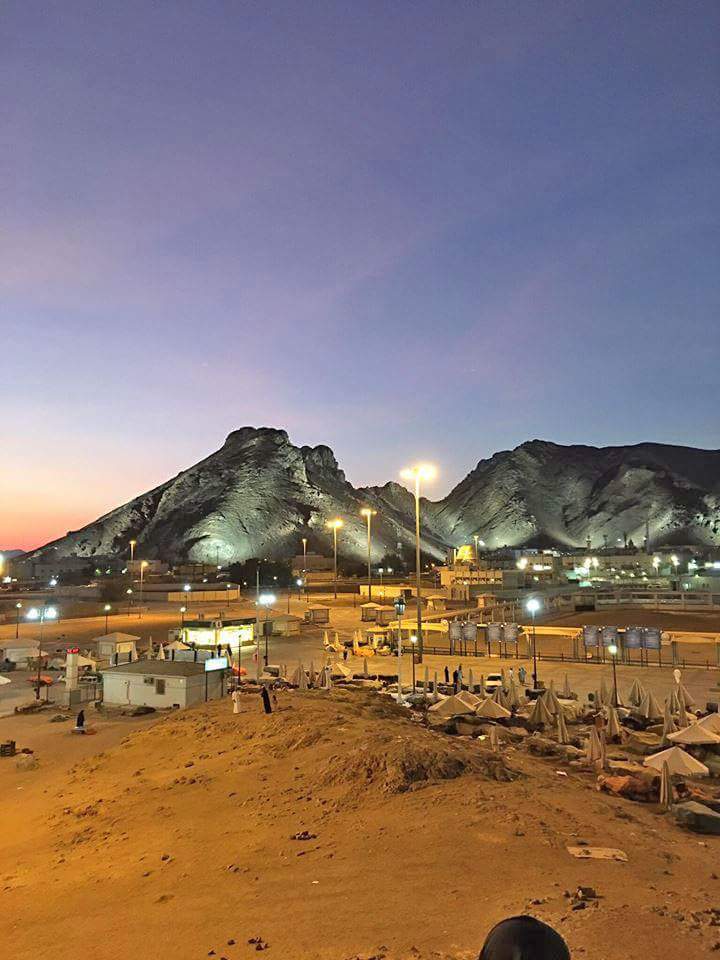
Images of Mount Uhud in Madinah

Images of Mount Uhud in Madinah

Images of Mount Uhud in Madinah

Images of Mount Uhud in Madinah

Images of Mount Uhud in Madinah

Images of Mount Uhud in Madinah

Images of Mount Uhud in Madinah


About Mount Uhud in Madinah

The mountains in the area of Al-Madinah Al-Munawwarah witnessed significant events in Islamic history. Among these mountains is Mount Uhud, which was the scene of the famous Battle of Uhud. Mount Uhud is a mountain north of Medina, Saudi Arabia. It is 1,077 m (3,533 ft) high. It was the site of the second battle between Muslim and Meccan forces.

Mount Uhud, in front of which the second battle in Islam (the Battle of Uhud) took place in 3 AH. Of this mountain the Prophet (peace and blessings of Allah be on him) declared, “This mountain loves us and we love it.” 

Mount Uhud is located 5 kilometers (3.1 miles) north of Madinah. Uhud has an attractive look. The Prophet (peace and blessings be upon him) felt relieved on seeing it, and the people of Madinah also loved it very much.

Mount Uhud extends from east to west with a slight slope towards the north. It is 7 kilometers (4.3 miles) in length and from 2 to 3 kilometers (1.2 to 1.9 miles) in breadth. Most of its stones are of red granite, and some parts of it are almost dark green and black. It contains some natural cavities (called maharis) where rain water is collected. The rain water remains throughout the year, for these cavities are not exposed to the rays of the sun. Close to Mount Uhud there are some small mounts, like Thawr and `Aynayn. Mount Thawris located northwest of Uhud, while `Aynayn is situated to its southwest.

Mount Uhud is also called the Archers' Mount because it was the field where the steadfast archers in the Battle of Uhud were killed.

The Prophet (peace and blessings be upon him) marched out with the Muslims to confront them. The Prophet (peace and blessings be upon him) took up his position below the hill. He (peace and blessings be upon him) arrayed the army in fighting formations, and fifty archers were posted on Mount `Aynayn under the leadership of `Abdullah ibn Jubayr to guard the army from any attack from the rear. They had strict orders not to leave their post, whatever the outcome of the battle.

The two armies engaged in fighting. The Muslims seemed to have won victory over the Makkans, who fell back in disorder after paying a heavy toll. The Muslims started gathering the booty. Thinking that the fight was over, the majority of the Muslim archers left their posts to gather the spoils, disregarding the orders of their leader to stay in their positions.

On seeing the archers leaving their posts, Khalid ibn Al-Walid, who had not yet embraced Islam, seized the opportunity and gathered a group of the Quraysh fighters, killed the rest of the archers, and launched a furious attack from the rear. The Muslims were taken so much by surprise that they did not know what to do. In the general melee their ranks got disorganized. Seventy of the Prophet's Companions, including Hamza ibn `Abdul Muttalib, the Prophet's uncle (may Allah be pleased with them), were killed.

After the battle was over, the martyrs were buried in the field of the battle. The Prophet (peace and blessings be upon him) would visit their graves and pray for them.

`Abbas ibn Sahl reported from Abu Humayd who said: We went out along with Allah's Messenger (peace and blessings be upon him) in the expedition of Tabuk. We proceeded until we reached the Valley of Al-Qura and Allah's Messenger (peace and blessings be upon him) said, "I am going forth, so he among you who wants to move fast with me may do so; and he who likes to go slowly may do so." We proceeded until Madinah was within our sight, and he said, "This is Uhud, the mountain which loves us and which we love."

Qatadah reported from Anas ibn Malik (may Allah be pleased with him) who said: Allah's Messenger (peace and blessings be upon him) said, "Uhud is a mountain which loves us and which we love."

Source : http://www.ummah.com/
Related Posts Plugin for WordPress, Blogger...