Showing posts with label Islamic Basics. Show all posts

Thursday, November 14, 2019

How to get Barakah in our home

How to get Barakah in our home ( Important Keys)

Means of attaining Barakah in our homes: 

Barakah a word we here often but sadly we have lost it in our homes, so we find no barakah in time, nor in sustenance or our wealth and children, so what then is the key to barakah. 


How to get Barakah in our home


There are 8 keys to attaining barakah :

1-Tilaawah of the Quraan: 

Allah has made the Quraan al Kareem a source of barakah, if we ponder over its meaning and we live our lives according to its teachings . And for this reason our beloved messenger said about the home in which Quraan is recited, the malaaikahs live in it, the shaithaans flee from it and it expands for the family and goodness increases in it.


2- Saying Bismillah and making the zikr of Allah: 

The messenger said: if a man enters his home and he mentioned Allahs name upon his entrance and before he ate, Shaithaan says to his companions, there is no home nor food for you here. 


3. Sadaqah: 

From the means of attaining barakah in a home is to give sadaqah. Especially secret sadaqah because it extinguishes the anger of Allah. 


4. Maintaining family ties: 

And indeed our messenger has informed us that maintaining family ties, and observing good character, increases our sustenance and our lives.

5. Waking up early to search for your rizq: 

It is mentioned in a Hadith ( Give glad tidings to my ummah in the early parts of the day) Which means - those who leave their homes to search for their rizq in the early parts of the morning. 


6. Establishing salaah on its fixed time is a means of attaining barakah: 

And enjoin As-Salat (the prayer) on your family, and be patient in offering them  [i.e. the Salat (prayers)].  We ask not of you a provision , We provide for you. And the good end (i.e. Paradise) is for the Muttaqun .

7. Putting our trust in Allah as he should be trusted: 

As is mentioned in a Hadith, If you trust Allah as he should be trusted , he will sustain you as he provides for the birds, they leave hungry in search for food and return full. 

8. Seeking Repentance: 

Making lots of Istighfaar. And Istighfaar on its own is a means of Increasing our sustenance, Just as Nabi said: Whoever makes Istighfaar Allah will make a way out of every difficult situation for him, And he will ease his sorrow, and he will sustain him from where he perceives not. 


May Allah bless us with lots of barakah and contentment.

Luck In Islam

What does Islam say about luck?

Luck in Islam


In the Name of Allah, the Most Gracious, the Most Merciful.
As-salāmu ‘alaykum wa-rahmatullāhi wa-barakātuh.
Brother in Islam,
Linguistically, ‘luck’ means, apparent success brought about by chance. According to the oxford dictionary, the word luck means the force that causes good or bad things to happen. In Islam, we believe all good and bad is from Allah Ta’ala and everything happens exclusively by the command of Allah Ta’ala. In today’s context, the word ‘luck’ is commonly used to wish someone well, or to acknowledge a gift a person has been bestowed with. However, if a person uses the word luck and believes it to mean as defined by linguists, then it will be impermissible.
We, as Muslims believe that all things in this World are destined by Allah Ta’ala. Allah Ta’ala knows what has happened, what is happening and what will happen. Outwardly, certain things seem to be a cause of luck or coincidence. But a Muslim believes that his time of death, sustenance and means of livelihood were pre-determined by Allah Ta’ala when he was still a foetus in his mother’s womb. 
Hence, in the life of a Muslim there is no scope for luck or coincidence. Rather, he is to act according to the commands of Allah Ta’ala and his messenger (Sallallahu Alaihi Wassalam) and he is to believe that this is a form of taking necessary worldly measures and the results are up to Allah Ta’ala.
With regards to the word حظ, there are different definitions given by linguists of the Arabic language, including; fortunate, lucky and portion. The word appears seven times in the Quran. In some verses, the word is translated as fortunate, whilst in other it is translated as portion.
You have made reference to the following verse:

وَمَا يُلَقَّاهَا إِلَّا الَّذِينَ صَبَرُوا وَمَا يُلَقَّاهَا إِلَّا ذُو حَظٍّ عَظِيمٍ (فصلت: 35)

Translation: ‘None is granted it except one having a great portion (of good).’
Exegetes have mentioned that the interpretation of حظ عظيم could mean those who will earn most rewards, whilst others say it could mean Jannah. Therefore, using this verse to prove that Muslims believe in luck, is incorrect. Yes, indeed, a person will be lucky if he is granted the qualities mentioned in this verse because, in our custom, the word luck also refers to someone who has been blessed with a bounty from Allah Ta’ala. Hence, using the word luck in its common usage today and believing in its original concept are two different things.
Another verse of the Quran wherein the word حظ is used:

فَخَرَجَ عَلَى قَوْمِهِ فِي زِينَتِهِ قَالَ الَّذِينَ يُرِيدُونَ الْحَيَاةَ الدُّنْيَا يَا لَيْتَ لَنَا مِثْلَ مَا أُوتِيَ قَارُونُ إِنَّهُ لَذُو حَظٍّ عَظِيمٍ (قصص: 79)

Translation: ‘So he emerged among his people in pomp and splendour. Those who desired the world gaped, “if only we also possessed what Qaroon has! Undoubtedlyhe is the owner of great fortune”.’
In this verse, Ibn Abbas (Radhiyallahu Anhu) and many other exegetes have mentioned that the words, حظ عظيم, refer to the vast portion of the Dunya that was given to Qaroon.

And Allah Ta’āla Knows Best.
Checked and Approved by,
Mufti Ebrahim Desai.

Tuesday, December 13, 2016

Islamic New Year Wallpapers Collections

Islamic New Year Wallpapers Collections

Islamic New Year Wallpapers Collections

Islamic New Year Wallpapers Collections

Islamic New Year Wallpapers Collections

Islamic New Year Wallpapers Collections

Islamic New Year Wallpapers Collections

Islamic New Year Wallpapers Collections

Islamic New Year Wallpapers Collections

The Islamic calendar, Muslim calendar or Hijri calendar (AH) is a lunar calendar consisting of 12 months in a year of 354 days. The Islamic lunar calendar (also referred to as Hijri calendar) is a purely lunar calendar. 

It contains 12 months that are based on the phases of the moon. Each lunar month is approximately 29.53 solar days. Therefore, the Islamic calendar is shorter than the Gregorian calendar. 12 lunar months is about 12 x 29.53=354.36 days (10 to 11 days shorter than the solar calendar). This why you may have noticed that the month of Ramadan and the time of Hajj gets earlier each year. 

 The Islamic lunar calendar, was first introduced in 638 AD by the second Caliph (Khalifa in Arabic), `Umar ibn Al-Khattab. The starting point of the calendar however was set to about sixteen years earlier, to mark the Hijrah — i.e. the time of emigration of the prophet Muhammad from Mecca to Medina. The word hijrah means to leave a place to seek sancturary or freedom from persecution or freedom of religion (or any other purpose). The emigration to Medina was a historic event, as it marked the turning point from persecution to freedom and acceptance of Submission (Islam in Arabic). 

The actual starting date for the Calendar was chosen to be the first day of the first month (1 Muharram) of the year of the Hijrah. The Islamic (Hijri) calendar is usually abbreviated A.H. in Western languages (similar to A.D. used to mark the Christian calendar). Muharram 1, 1 A.H. corresponds to July 16, 622 A.D.
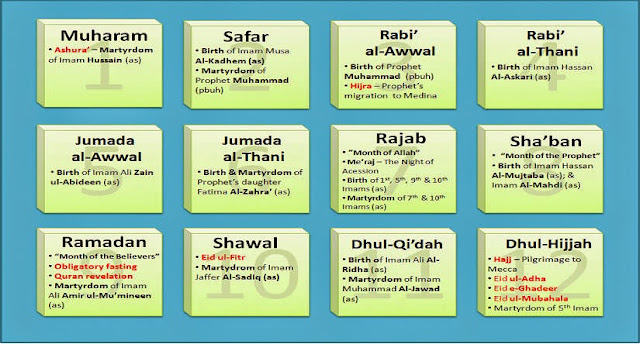
  1. Muharram
  2. Safar
  3. Rabi-ul-Awwal
  4. Rabi-ul-Aakhir
  5. Jumada-al-Oolaa
  6. Jumada-al-Aakhirah
  7. Rajab
  8. Sha'ban
  9. Ramadhan or Ramzan
  10. Shawwal
  11. Zul-Qa'dah
  12. Zul-Hijjah
Islamic New Year Wallpapers Collections

Sunday, December 11, 2016

The 15th Night of Shaaban

If a person wants to fill a container he will first ensure that the container is clean. If the container is not clean he will first clean the container then he will fill it up. Likewise, if we want to fill his heart with the blessings of Ramadhān then we will first have to clean our hearts. If we are not prepared to fill ordinary water in a dirty glass how then we expect to fill a dirty heart with the pure blessings and mercies of the blessed month of Ramadhān? 
Allāh through His infinite mercy blessed us with the night of emancipation, the night of the 15th of Sha’bān so that we may clean and purify our hearts so that when Ramadhān comes we are able to fill our hearts with the immense goodness it brings along.
The 15th Night of Shaaban
The night of the 15th of Sha’bān is a night of turning to Allāh  in repentance. It is also an opportunity to patch up with fellow human beings. It is an occasion to clean up our hearts so that when Ramadhān comes we are ready to fill up our hearts and gain maximum benefit from this auspicious month.
We are thought in the aḥādīth that on this night Allāh  forgives His entire creation except those who ascribe partners unto Him. Another narration mentions that Allāh  forgives so many people on this night as to the amount of wool on the sheep of the tribe named Kalb. 

Dua To Be Recited On This Night 

أَعُوْذُ بِعَفْوِكَ مِنْ عِقَابِكَ وَأَعُوْذُ بِرِضَاكَ مِنْ سَخَطِكَ وَأَعُوْذُ بِكَ مِنْكَ إِلَيْكَ

لَا أُحْصِيْ ثَنَاءً عَلَيْكَ أَنْتَ كَمَا أَثْنَيْتَ عَلىَ نَفْسِكَ

I seek protection in Your forgiveness from Your punishment

And I seek protection in Your happiness from Your anger

And I seek protection in You from You

I am unable to praise You

You are as You praised Yourself.

Written By: Mufti Ishaaq E Moosa (Student of Mufti Ebrahim Desai)
Checked and Approved by,
Mufti Ebrahim Desai
Source: http://www.idealwoman.org/2014/the-month-of-shaban/

Dua For Rajab and Shaaban

Dua in shaaban Month

Hadeeth About Shaaban Month

Wednesday, December 7, 2016

Ten Blessed Days of Dul Hijjah

It is the time of the year again when we see millions of people from every corner of the world gathering in Makkah for Haj, which is the largest annual religious gathering that humanity knows. It is not just the number of people, but also the diversity that is stunning. Indeed, the heart of every believer soars with joy and the eyes well up when they watch the live transmissions being aired from the holy sites and every single one of them wishes that he/she was one of the blessed ones performing Haj.

It all started when Allah commanded Prophet Ibrahim (peace be upon him) to build His House, purify it and then call people to it for pilgrimage. Allah talks about this, in Surah Al Haj and says: “And when We designated for Ibraheem the site of the House, [saying], ‘Do not associate anything with Me and purify My House for those who perform Tawaf and those who stand [in prayer] and those who bow and prostrate. And proclaim to the people the Haj; they will come to you on foot and on every lean camel; they will come from every distant pass.’” (Qur’an 22:26-27)

Ibn Katheer said in his commentary on these verses: “This means: Allah says, Proclaim (O Ibrahim) the Haj to the people, calling them to come on pilgrimage to this House which We have commanded you to build. It was mentioned that Ibrahim said, “O Lord, how can I proclaim it to the people when my voice does not reach them?” He said, “Call and We will convey it.” So he stood in his maqaam (Station of Ibraheem) — or it was said, on the rock, or on Al-Safa, or on Abu-Qubays (a mountain) — and said: “O people, your Lord has taken a House, so come to it on pilgrimage.”

Ten Blessed Days of Dul HijjahPraise be to the One Who has made His House "a place of return for the people and (a place of) security." (2:125). The hearts of those who love Allah are naturally attached to the House of the Beloved. Every time they see its image from afar they long for it and every time they are away from it they want to return. Although this narration amazes us, it also saddens many who are unable to undertake this amazing journey, either due to financial reasons, family obligations, or any other reason that may exist. Allah knows the state of hearts and He is especially Merciful toward His believing slaves when He decrees that whenever one resolves to do an act of worship but he is unable to do it because of some excuse, he will be granted the reward of one who does it.

This is proven by the incident when the Messenger (peace be upon him) came back from the campaign of Tabook and when he drew close to Madinah he said: “In Madinah there are some people who, whenever you marched or crossed a valley, were with you (gaining similar rewards).” The companions said: “O Messenger of Allah, but they were in Madinah.” He said, “They were in Madinah because some excuse kept them back.” (Al-Bukhari-4423)

We can also get the ultimate rewards of Haj, right from where we are. According to a Hadith, whoever prays Fajr prayer in congregation, then sits and remembers Allah until the sun rises, and then prays 2 rakahs of voluntary prayer (Al-ishraq), he will gain a reward equal to that of performing a perfect, perfect, perfect Haj and Umrah. (Al-Albaani, Saheeh Al-Jaami’-6346)

Furthermore, Allah has made the month of Haj, Dul-Hijjah blessed, and the first ten days of this month have been made the best ten days of the year so all good deeds done in this season carry extra rewards.

The evidence of this has been reported in both the Qur’an and the Sunnah. Allah says: “By the dawn. And by the ten nights.” (Qur’an 89:1-2) The ten nights refer to the first ten days of Dul-Hijjah according to Ibn Abbas, Mujahid and others. (Tafsir Ibn Katheer)

The Messenger (peace be upon him) said, “There are no days in which righteous actions are more beloved to Allah than these ten days...” (Al-Bukhari, 2/457)

Therefore, for those of us who are unable to be in Makkah right now for Haj, let’s value these special days of the year and maximize our efforts to excel in various good deeds. We can:

— Pray all obligatory prayers on time and try to pray extra voluntary prayers for extra reward.
— Fast as the Prophet (peace be upon him) used to fast on the first nine days of Dul-Hijjah. (Saheeh Abi Dawood-2/462). And when the Prophet (peace be upon him) was asked about fasting on the 9th — The Day of ‘Arafah, he said: “It expiates (sins) for the past year and the coming year.” (Muslim-1162)
— Keep our tongues moist with Takbeer (Allahu-Akbar), Tahmeed (Alhamdulillaah), Tahleel (La ilaha ill-Allah) and Tasbeeh (SubhanAllah)
— Try to read the Qur'an as much as possible as ‘every letter earns us more than ten rewards’ (Tirmidhi-2910).
— Increase in our worship, repentance and dua during the day and during the night.
— Give charity and help those who are less fortunate to prepare for Eid.
— Restrain our tempers and our tongues from evil or idle talk, try being patient in upholding ties with relatives even if they are rude to us.
— Share sacrificial meat with the poor and be cheerful with everyone.
Ten Blessed Days of Dul Hijjah
These ten days are truly special days of great gains and profits. The smart trader is the one who makes the most of this special season to increase his profits and seek nearness to His Master, whether he is at Makkah or not. May Allah guide us to be of the wise ones who do their best to get the maximum reward. Ameen.
Source : http://www.arabnews.com/node/978751/islam-perspective

Ten Blessed Days of Dul Hijjah

Monday, November 28, 2016

Rules of Leather Normal Socks Making Masah

Shariah has permitted making masah on Khuffain (leather socks) with the following conditions. 
  • They cover the feet upto and including the ankle
  • It is possible to walk in them for 3 Shari’ miles
  • Must be able to stand on its own because of its thickness, (not because of its elasticity or tightness)
  • Water should not seep through and reach the feet.
It is permissible for one to make Masah on the Khuffain as a substitute for making Wudhu on condition one make’s complete Wudhu before wearing the leather socks. Moreover, the Masah will be valid for one day and one night for a non-traveller (Muqeem) and three days and three nights for a traveller (Musafir) from the time one’s wudhu breaks. 

Masah should be made on the top section of the leather socks and not of the soles. The method of performing the masah is that after wetting the fingers, they should be placed in the front i.e. the toes. Place the fingers flat on the socks with the palms away from them. Thereafter, draw or pull the fingers towards the ankles. If the palms are also placed flat on the socks together with the fingers, it will be permissible.


Sayyiduna ‘Amr ibn Umayya Damri (Radiallahu Anhu) reports: I saw Nabi (صلى الله عليه و سلم) making masah of his leather socks and turban. [Sahihul-Bukhari Vol 1 Page 33]

It is a well-known fact that wiping over Khuffain (leather socks) in place of washing feet in Wudhu is valid.  Hāfidh Ibn Al-Hajar Rahimahullāh states in his commentary on Sahīh Al-Bukhārī:

“It has been narrated on the authority of Sa’d Ibn Abi Waqqās Radiallahu Ta’āla Anhu that the Prophet Sallallahu Alaihi Wa Sallam used to perform masāh over the leather socks.” (Sahih Al-Bukhari 1/51)

“It has been reported by Urwā Ibn Mugheerāh Radiallahu Ta’alā Anhu on the authority of his father that the Prophet Sallallahu Alaihi Wa Sallam performed wudu and then after performed masāh over the leather socks….” (Sahih Muslim 1/230)

It has been reported that Hasan Al-Basri Rahmatullahi Alaihi said: “I encountered a group of seventy Sahābah Radiallahu Ta’alā Anhum. Each one of them held the view of performing masāh over the leather socks.” (Al-Muheet Al-Burhāni Fi Fiqh An-Nu’mani 1/167)

Leather socks are tight fit and are not bulky like shoes or boots. 

It is possible to make masah on leather socks and read Salah the Sunnah way with the leather socks. 

Ridhwan Ur Rahman, Student Darul Iftaa,Cardiff, Wales, UK 
Checked and Approved by, Mufti Ebrahim Desai

1. Wiping [masah] over leather socks or those socks that are similar to leather socks in their properties is one thing and wiping on regular socks is a totally different thing with the latter having no no proof or basis.

2. It is only permissible to wipe on those socks which are similar to leather socks, meaning they have the following characteristics:

a.) They are not transparent and water does not seep through and reach the feet.
b.) Due to their thickness, they stay upright on their own (without tying them).
c.) It is possible to walk at least 3.45 miles (1 farsakh = 3 Shar'i miles x 1.15 = 3.45 miles) in these socks without tearing them.

The following response is adapted from a fatwa by Mufti Taqi Uthmani (may Allah preserve him) with additions as appropriate in response to the points presented in the inquiry. 

No Authentic Hadith On Wiping Over “Jawrabayn”:

→ There is no authentic hadith that proves the permissibility of wiping [masah] over jawrabayn, not even one. 
→ There are 3 weak ahadith that mention wiping over “jawrabayn” - and by “jawrabayn”  is not meant the thin, regular socks common in our time

All of the four mujtahid Imams (Imam Abu Hanifa, Imam Malik, Imam Shafi and Imam Ahmad) are unanimous and there is a consensus on the fact that it is not permissible to wipe over thin socks. This goes to show how important this issue is in that it goes against the consensus of all four Imams whose superiority in fiqh is paramount and admitted by all.

In 'Awn al-Ma'bud, a commentary of Sunan Abu Dawud, the author has stated that “jawrab” can be from leather, wool, or cotton and each one is referred to as “jawrab”. However, he states that permissibility of making masah on regular socks cannot be given until it is established that Rasulullah (salallahu alayhi wa sallam) made masah on socks made from (for example) wool.

How was a jawrab in the time of the companions and the followers?
→ Yes, the Sahabah (may Allah be pleased with them) made masah on socks that were thick and similar to leather socks in their properties, not the socks that are in regular use today.
→ Mufti Taqi Uthmani (may Allah preserve him) writes that there is no evidence to show that the Sahabah (may Allah be pleased with them) made masah on thin socks. 

→ The article quotes Imam Nawawi (may Allah have mercy on him) relating that it is reported from Umar and Ali (may Allah be pleased with them both) about the permissibility of making masah on socks even if they are thin. However, this report is contradictory because in the same sentence, Imam Nawawi mentions that this view (of wiping on thin socks) is also the view of Ishaq, Abu Yusuf and Muhammad (may Allah have mercy on them). [vii] However, these three are of the view that the socks have to be thick as mentioned by Imam Tirmidhi (may Allah have mercy on him) and also clarified further in Tuhfa al-Ahwazi and 'Awn Al-Ma'bud.  

Secondly, another eminent Sha'fi scholar, Umrani (may Allah have mercy on him) mentions in Bayan that what is, in fact related from Umar and Ali (may Allah be pleased with them both) concerns thick, strong sock [jawrab safiq] 

 In the presence of contradictory statements we cannot give weight to the permissibility of masah on thin socks, especially since statements from leading followers [ta'bin] who saw what the Sahabah (may Allah be pleased with them) wore with their own eyes and made it a  condition that these socks be thick and strong for masah to be permissible:

“It is related that Said ibn Al-Musayyab and Hasan al-Basri stated: '(It is allowed) to do masah on those socks which are thick and strong [safiq].

Mufti Taqi Uthmani (may Allah protect him) states that the above fatwa of these two eminent followers establishes that the type of socks worn by the Sahabah (may Allah be pleased with them) were none other than the type that are similar to leather socks in their characteristics.

Rules of Leather Normal Socks Making Masah The definition of thick and strong [safiq] as defined by our jurists [fuqaha] is mentioned in the beginning of this answer.

Ibn Qayyim's View

→ What has been mentioned about the views of Ibn Qayyim or Ibn Uthaymeen (may Allah have mercy on them) approving the use of all types of socks, then with due respect to their knowledge, this is an opinion that goes against the overwhelming majority: Imam Abu Hanifa, Imam Shafi, Imam Malik, Imam Ahmad, Abdullah ibn Mubarak, Sufyan al-Thawri, Hasan al-Basri, Said ibn al-Musayyab (may Allah have mercy on them) and many others. The view of the former group also has no concrete proof that would establish that the jawrab can be of any type and does not need to be like the khuff in its characteristics. 

Some experts of Hadīth have gathered the (number of) Companions who narrate Ahādīth with regards to wiping over Khuffain and they (the Companions) reached over eighty (in number). (Fath Al-Bārī)

The common word used in books of Ahādīth for socks is خفين (Khuffain).  Khuffan refers leather socks.  Another word used isجوربين  (Jawrabain) which are socks made from wool, cotton, etc.   

Jawrabain are further divided into three types:

1.منعلين (Muna’alain) – The soles (bottom of the socks) have leather.

2.مجلدين(Mujalladain)-  The top and bottom have leather.  

3.Plain Jawrabain- This does not have leather at all

There are four conditions for socks to be classified as thick.  Allāmah Haskafi Rahimahullāh mentions in his work named “Ad-Durr Al-Mukhtār”:

Characteristics of thick socks:

1.Must be able to walk 3 Shari’ miles without tear

2.Must be able to stand on its own because of its thickness, (not because of its elasticity or tightness)

3. Water should not seep through and reach the feet

4. Must not be transparent that the foot is visible (Radd Al-Muhtār) 


In conclusion, the following points are clear from the aforementioned information:

1. It is permissible to wipe over full leather socks.

2. It is permissible to wipe over Mujalladain (leather on top and bottom of the socks).

3.With regards to non-leather socks that do not have any leather, they must meet the requirements of thickness in order for wiping to be valid. 

4.Non-leather thin socks like the cotton and nylon socks etc. are unanimously impermissible for wiping. 

In issues of Ibādāt (worships) like Wudhu, Salāh, Haj, etc. we should exercise precaution as it is our means of communicating with Allāh and relating to Allāh.  Allāh is perfect.  We should offer our best to Allāh.  We should thus abstain from anything that is doubtful.  Every endeavor should be made to make our acts of worship acceptable to Allāh.  Wudhu is a pre-requisite for the validity of Salāh.  Rasullullāh Sallallāhu Alaihi Wa Sallam has stated:

“The key to Salāh is purification.” (Sunan At-Tirmidhī, Vol. 1, Page 6) 

How does one make masah on leather socks during wudhu ?

It is fardh to make masah equal to the area of three fingers on each leather sock. The preferable method of making masah is that it should be made with the palm-side of the hands and on the top of the leather sock. Once the fingers are wet, place them flat on the socks with the palms away from them, thereafter pull the fingers towards the ankles. 

(Badaa’iu Al Sanaai’i V-1, P-87-88 Darul Kitaab) (Bahishti Zewar P-86 Zam Zam)

It is permissible for one to make Masah on the Khuffain as a substitute for making Wudhu on condition one make’s complete Wudhu before wearing the leather socks. Moreover, the Masah will be valid for one day and one night for a non-traveller (Muqeem) and three days and three nights for a traveller (Musafir) from the time one’s wudhu breaks. 

The washing of feet in wudu is a direct injunction of the Qur’an.  Allah Ta’ala says:

يَا أَيُّهَا الَّذِينَ آَمَنُوا إِذَا قُمْتُمْ إِلَى الصَّلَاةِ فَاغْسِلُوا وُجُوهَكُمْ وَأَيْدِيَكُمْ إِلَى الْمَرَافِقِ وَامْسَحُوا بِرُءُوسِكُمْ وَأَرْجُلَكُمْ إِلَى الْكَعْبَيْنِ (المائده)

O you who believe, when you rise for Salah, wash your faces and your hands up to the elbows, and make Masah (wiping by hands) of your head and (wash) you feet up to the ankles. (al-Ma’idah – 6)

Tuesday, November 8, 2016

The Basic Five Principles Of Islam

Narrated Ibn 'Umar:
Allah's Apostle said: Islam is based on (the following) five (principles):
1.  To testify that none has the right to be worshipped but Allah and Muhammad is Allah's Apostle.
2.  To offer the (compulsory congregational) prayers dutifully and perfectly.
3.  To pay Zakat (i.e. obligatory charity) .
4.  To perform Hajj. (i.e. Pilgrimage to Mecca)
5.  To observe fast during the month of Ramadan.
The Basic Five Principles Of Islam

Narrated Abu Huraira:
The Prophet said, "Faith (Belief) consists of more than sixty branches (i.e. parts). And Haya (This term "Haya" covers a large number of concepts which are to be taken together; amongst them are self respect, modesty, bashfulness, and scruple, etc.) is a part of faith."
Narrated 'Abdullah bin 'Amr:
A man asked the Prophet , "What sort of deeds or (what qualities of) Islam are good?" The Prophet replied, 'To feed (the poor) and greet those whom you know and those whom you do not Know

The Basic Five Principles Of Islam in Tamil

பின்வரும் நபிமொழியில் ஹஜ்ஜை இஸ்லாமிய ஐந்து தூண்களில் ஒன்றாகச் சொல்லப்பட்டுள்ளது: இஸ்லாம் ஐந்து அம்சங்கள் மீது நிறுவப்பட்டுள்ளது.
  1. அல்லாஹ்வைத் தவிர வணக்கத்திற்குரியவன் வேறு யாருமில்லைஎன்றும், முஹம்மத் (ஸல்) அவர்கள் அல்லாஹ்வின் தூதர் என்றும் உறுதியாக நம்புவது.
     
  2. தொழுகையை நிலைநிறுத்துவது.
     
  3. ஸகாத் வழங்குவது.
     
  4. (இயன்றோர் இறையில்லம் கஅபாவில்) ஹஜ் செய்வது.
     
  5. ரமளானில் நோன்பு நோற்பது.

இதை இப்னு உமர் (ரலி) அவர்கள் அறிவிக்கிறார்கள்.(ஸஹீஹுல் புகாரீ 8)

Thursday, November 3, 2016

About Ramdhan Taraweeh Prayer in Hadith

The following article, Taraweeh 8 or 20 is written by Moulana Zakariyya Memon as thesis for his Iftaa course. This article makes useful read to understand the issue clearly. The format is well laid out and well substantiated.
May Allah accept this article for His pleasure. Ameen.
Mufti Ebrahim Desai. 
Before we trace the source of twenty raka’at taraweeh, first consider the following Ahadith, sayings and practices of great illustrious personalities in Islam. 
عن السائب بن يزيد قال كانوا يقومون على عهد عمر بن الخطاب في شهر رمضان بعشرين ركعة وفي عهد عثمان )سنن البيهقي ص496/2(
Translation: Al-Saaib bin Yazeed (Radiyallahu Anh) narrated that we used to offer twenty raka’at followed by Witr in the reign of ‘Umar (Radiyallahu Anh) and ‘Uthman (Radiyallahu Anh).(Sunan Al-aihaqi, 2/496) 
وعن أبي عبد الرحمن السُّلَمي: أن عليّاً دعا القُرّاء في رمضان، فأمر رجلاً بأن يصلّي بالناس عشرين ركعة، وكان عليٌّ يوتر بهم. )التعليق الممجد على موطأ محمد (1/ 629(
Translation: Abi ‘Abdul Rahman Al-Salami (Radiyallahu Anh) narrated that ‘Ali (Radiyallahu Anh) called for the Huffaz Al-Qur’an in the month of Ramadan and asked one of them to lead people in offering twenty raka’at Salat (Al-Taraweeh) while he himself used to lead the Witr prayer.(Al-Taleeq Al-Mujaddad ala Muwatta’ Imam Muhammad, 1/629) 
وقَالَ الشَّافِعِيُّ: وَهَكَذَا أَدْرَكْتُ بِبَلَدِنَا بِمَكَّةَ يُصَلُّونَ عِشْرِينَ رَكْعَةً. سنن الترمذي ت بشار (2/ 162(
Translation: Imam Shaf‘i (Rahmatullahi ‘Alaih) said that I have always found people in Makkah offering twenty raka’at.(Sunan Al-Tirmizi, 2/162) 

عَنِ ابْنِ أَبِي الْحَسْنَاءِ، «أَنَّ عَلِيًّا أَمَرَ رَجُلًا يُصَلِّي بِهِمْ فِي رَمَضَانَ عِشْرِينَ رَكْعَةً» مصنف ابن أبي شيبة (2/ 163(
Translation: Abi Al-Hasana’ (Rahimahullah) narrated that ‘Umar (Radiyallahu Anh) ordered a person to lead twenty raka’at Salat (Al-Taraweeh) in the month of Ramadan.(Musannaf ibn abi shaibah, 2/163) 
عَن الْأَعْمَش عَن زيد بن وهب، قَالَ: (كَانَ عبد الله بن مَسْعُود يُصَلِّي لنا فِي شهر رَمَضَان) فَيَنْصَرِف وَعَلِيهِ ليل، قَالَ الْأَعْمَش: كَانَ يُصَلِّي عشْرين رَكْعَة ويوتر بِثَلَاث) . عمدة القاري شرح صحيح البخاري (11/ 127(
Translation: A‘amash (Rahimahullah) narrated from Zaid Bin Wahab (Rahimahullah) that Abdullah Bin Mas’ud (Radiyallahu Anh) used to offer….. twenty raka’at Salat (Al-Taraweeh) followed by three raka’at of Witr.(Umdatul Qari, 11/127)  
عَنْ نَافِعِ بْنِ عُمَرَ، قَالَ: " كَانَ ابْنُ أَبِي مُلَيْكَةَ يُصَلِّي بِنَا فِي رَمَضَانَ عِشْرِينَ رَكْعَةً، )مصنف ابن أبي شيبة (2/ 163(
Translation: Nafi’ (Rahimahullah) narrated that Ibn Abi Mulaikah (Rahimahullah) used to lead people in offering twenty raka’at Salat (Al-Taraweeh) in the month of Ramadan.(Musaanf ibn abi shaibah, 2/163) 
عن ابي الخصيب قال كان سويد بن غفلة يؤمنا في رمضان عشرين ركعة (الكنى للبخاري ص28 ح234)  
Translation: Abu Al-Khusaib (Rahimahullah) narrated that Suwaid bin Ghafalah (Radiyallahu Anh) always led us in offering twenty raka’at Salat (Al Taraweeh) in the month of Ramadan.(Al-kuna lil Bukhari, p28)  
عَنْ عَطَاءٍ، قَالَ: «أَدْرَكْتُ النَّاسَ وَهُمْ يُصَلُّونَ ثَلَاثًا وَعِشْرِينَ رَكْعَةً بِالْوِتْرِ» مصنف ابن أبي شيبة (2/ 163) 
Translation: ‘Ata (Rahimahullah) (who was a great Tabi’ee living in Makkah Mukkaramah) said: I always found people offering twenty-three raka’at including Witr.(Musaanf ibn abi Shaibah, 2/163) 
How Did Salat Al-Taraweeh Begin?
Once, in the holy month of Ramadan, the Prophet (Sallallahu Aliahi Wa Sallam) came out of his home and led Salat Al-Taraweeh.  The Sahabah (Radiyallahu Anhum) who were present at the time, prayed behind him in congregation.  The second and the third night, a larger number of Sahabah (Radiyallahu Anhum) came and performed Salat Al-Taraweeh behind the Prophet (Sallallahu Aliahi Wa Sallam).  On the fourth night, an even larger number of Sahabah (Radiyallahu Anhum) showed up in the Masjid expecting to pray this new salat behind the Prophet (Sallallahu Alaihi Wa Sallam). But, he did not come out to lead SalatAl-Taraweeh that night.  The Sahabah (Radiyallahu Anhum) waited all night. When the Prophet (Sallallahu Alaihi Wa Sallam) finally came for the Fajr prayer, he told them:
“I knew you were waiting for me, but I did not come out to lead Salat Al-Taraweeh last night because I was afraid it might become an obligation (Fard) on the Ummah which they might find difficult to fulfill.”  (Bukhari, h872; Muslim, h1271; Abu Dawood, h1166)
In other words, if it was obligatory like the rest of the five daily prayers, we would have to perform it even if we were traveling or ill etc. Since then, Sahabah (Radiyallahu Anhum) started to perform Salat Al-Taraweeh in small congregations in the Masjid and in their homes. 
How Many Raka’at Did The Prophet (Sallallahu Alaihi Wa Sallam) Perform In Those Three Nights?
 The great muhaddith, Hafiz Ibn Hajar (Rahmatullahi ‘Alaih), who is well-known for his interpretation of Sahih Al-Bukhari has reported in his book Al-Talkhees Al-Habeer on the authority of ‘Aisha (Radhiallahu anhaa) that the Prophet (Sallallahu Alaihi Wa Sallam) performed twenty raka’at Taraweeh in those three nights (Al-Talkhees Al-Habeer, h540).
Imam Ibn Habban (Rahmatullahi ‘Alaih) on the other hand, has reported a hadith in which it is stated that the Prophet (Sallallahu Alaihi Wa Sallam) performed eight raka’at of Taraweeh in those three nights. However, this hadith is extremely weak because one of the narrators in the chain is Isa Ibn Jaariyah. Imam Nasa`i (Rahmatullahi ‘Alaih) and Imam Abu Dawood (Rahmatullahi ‘Alaih) have strongly questioned the authenticity of this narrator. Therefore, both of these Imams of hadith rejected his hadith.
However, even if the hadith narrated by Isa Ibn Jaariyah was not weak, it would still not be adopted because it goes against a clearly established practice and unanimity of Sahabah (Radiyallahu Anhum). As a rule of Islamic jurisprudence, any hadith that goes against the clearly established practices and unanimity of Sahabah (Radiyallahu Anhum), will not be accepted for practice. 
قَالَ أَبُو دَاوُدَ: «إِذَا تَنَازَعَ الْخَبَرَانِ عَنْ رَسُولِ اللَّهِ صَلَّى اللهُ عَلَيْهِ وَسَلَّمَ نُظِرَ إِلَى مَا عَمِلَ بِهِ أَصْحَابُهُ مِنْ بَعْدِهِ» سنن أبي داود (1/ 191) 
Translation: Imam Abu Dawood (Rahmatullahi ‘Alaih) states that if there were two apparently contradictory ahadith, we would adopt the one that is confirmed by the established practices of Sahabah (Radiyallahu Anhum. (Abu Dawood, 1/263) 
عن مالك، أنه سمعه يقول: إذا جَاءَ عَنِ النَّبِيِّ صَلَّى اللَّهُ عَلَيْهِ وَسَلَّمَ حديثان مختلفان وبَلَغَنا أنَّ أبا بكر وعمر عَمِلا بأحد الحديثين وتركا الآخر، كان ذلك دليلاً على أن الحق في ما عملا به، كذا في "الاستذكار". التعليق الممجد على موطأ محمد (1/ 229) 
Translation: Imam Malik (Rahmatullah ‘Alaih) says that if we come across two seemingly contradictory Ahadith and if we know that AbuBakr (Radiyallahu Anh) and ‘Umar (Radiyallahu Anh) practiced one of them and left the other, then this would be proof enough for us for its authenticity. (Al-Ta’leeq Al-Mumajjad, 1/43)
In any event, the above two ahadith narrated by ‘Aisha (Radiallahu anhaa) and Ibn Jaariyah (Rahmatullahi Alaih) are related only to three nights. 
How Many Raka’at Did The Prophet (Sallallahu Alaihi Wa Sallam) Perform for Salat Al-Taraweeh in the Remainder of the Nights?
عَنِ ابْنِ عَبَّاسٍ، «أَنَّ رَسُولَ اللَّهِ صَلَّى اللهُ عَلَيْهِ وَسَلَّمَ كَانَ يُصَلِّي فِي رَمَضَانَ عِشْرِينَ رَكْعَةً وَالْوِتْرَ» مصنف ابن أبي شيبة (2/ 164( 
Translation: Ibn Abbas (Radiyallahu Anh) narrated that the Prophet (Sallallahu Alaihi Wa SAllam) used to pray twenty raka’at followed by Witr in the month of Ramadan.(Musannaf ibn abee shaibah, 2/164)  
عَنِ ابْنِ عَبَّاسٍ قَالَ: " كَانَ النَّبِيُّ صَلَّى اللهُ عَلَيْهِ وَسَلَّمَ يُصَلِّي فِي شَهْرِ رَمَضَانَ فِي غَيْرِ جَمَاعَةٍ بِعِشْرِينَ رَكْعَةٍ، وَالْوِتْرِ " السنن الكبرى للبيهقي (2/ 698(
Translation: Ibn Abbas (Radiyallahu Anh) narrated that the Prophet (Sallallahu Alaihi Wa Sallam) used to pray twenty raka’at by himself followed by Witr (every night) in the month of Ramadan.(Al-Sunan Al-Kubra, 2/698) 
These Ahadith very clearly prove that even though the Prophet (Sallallahu Alaihi Wa Sallam) did not continue to perform Salat Al-Taraweeh with the congregation because of the fear that it might become Fard on the Ummah, he regularly performed twenty raka’at of Salat Al-Taraweeh every night during the month of Ramadan. Sahabah (Radiyallahu Anhum) also followed this practice in small congregations until the reign of ‘Umar (Radiyallahu Anh). 
About Ramdhan Taraweeh Prayer in Hadith
The Sahabah (Radiyallahu Anhum) were unanimous on twenty Raka’at. 
عَنْ عَبْدِ الرَّحْمَنِ بْنِ عَبْدٍ القَارِيِّ، أَنَّهُ قَالَ: خَرَجْتُ مَعَ عُمَرَ بْنِ الخَطَّابِ رَضِيَ اللَّهُ عَنْهُ، لَيْلَةً فِي رَمَضَانَ إِلَى المَسْجِدِ، فَإِذَا النَّاسُ أَوْزَاعٌ مُتَفَرِّقُونَ، يُصَلِّي الرَّجُلُ لِنَفْسِهِ، وَيُصَلِّي الرَّجُلُ فَيُصَلِّي بِصَلاَتِهِ الرَّهْطُ، فَقَالَ عُمَرُ: «إِنِّي أَرَى لَوْ جَمَعْتُ هَؤُلاَءِ عَلَى قَارِئٍ وَاحِدٍ، لَكَانَ أَمْثَلَ» ثُمَّ عَزَمَ، فَجَمَعَهُمْ عَلَى أُبَيِّ بْنِ كَعْبٍ،) صحيح البخاري (3/ 45)  
During the reign of hadhrat ‘Umar (Radiyallahu Anh), he (‘Umar Radiyallahu Anh) once went to the masjid in the month of Ramadan and noticed that people were performing Salat (Al-Taraweeh) in small congregations. He said to the Sahabah (Radiyallahu Anhum), “Now that we do not have the fear that Salat Al-Taraweeh will become Fard on us, we can start performing it in congregation.” 
He then asked Ubai Ibn Ka’ab (Radiyallahu Anh) to lead Salat Al-Taraweeh - twenty raka’at followed by three raka’at Witr (Sahih Bukhari).
Sahabah (Radiyallahu anhum) welcomed ‘Umar’s (Radiyallahu Anh) suggetion.  From then on they used to perform twenty-three raka’at Salat Al-Taraweeh; including the Witr every night in congregation during the month of Ramadan.  All of the Sahabah (Radiyallahu Anhum) including ‘Uthman (Radiyallahu Anh), ‘Ali (Radiyallahu anh), and even Ummahatul Mu’mineen ‘Aisha (Radiallahu anhaa), Umm Salmah (Raadhiallahu anhaa), and Safiyyah(Radhiallahu anhaa) agreed with ‘Umar (Radiyallahu Anh). All of them used to perform these twenty three raka’at every night during the month of Ramadan in the masjid of the Prophet (Sallallahu Alaihi Wa Sallam). This clearly proves that indeed this is the Sunnah of the Prophet (Sallallahu Alaihi Wa Sallam). Otherwise, Sahabah (Radiyallahu Anhum) would have never agreed to it.
It is narrated in Kanz Al-‘Ummal, a well-known book of Hadith:
عن أبي بن كعب أن عمر بن الخطاب أمره أن يصلي بالليل في رمضان…… فصلى بهم عشرين ركعة. كنز العمال (8/ 409(
Translation: Ubai bin Ka’ab (Radiyallahu Anh) narrated that ‘Umar (Radiyallahu Anh) ordered him to lead Salat (Al-Taraweeh) during the nights of Ramadan. So, I led people (Sahabah and Tabi’een) in praying twenty raka’at.(Kanz Al-Ummal, 8/409)  
عن السائب بن يزيد قال كنا نقوم في زمن عمر بن الخطاب بعشرين ركعة والوتر (سنن البيهقي ص296/1) قال النووي إسناده صحيح )شرح المهذب ص32/4 وصححه السبكي و السيوطي وعلي القاري(
Translation: Al-Saaib bin Yazeed (Radiyallahu Anh) narrated that we used to offer twenty raka’at followed by Witr in the reign of ‘Umar (Radiyallahu Anh). (Sunan Al-Baihaqi, v1, p296)  Imam Nawawi (Rahmatullahi ‘Alaih) has confirmed the authenticity of this hadith in his book “Sharh Al-Muhazzab, v4, p32”, as well as Imam Subki in his Sahih).(Sharhul Mhazzab, 4/32) 
عن السائب بن يزيد قال كانوا يقومون على عهد عمر بن الخطاب في شهر رمضان بعشرين ركعة وفي عهد عثمان (سنن البيهقي ص496/2(
Translation: Al-Saaib bin Yazeed (Radiyallahu Anh) narrated that we used to offer twenty raka’at followed by Witr in the reign of ‘Umar (Radiyallahu Anh) and ‘Uthman (Radiyallahu Anh).(Sunan Al-Baihaqi, 2/496) 
Is it even remotely imaginable that all of the Sahabah (Radiyallahu Anhum) including ‘Uthman (Radiyallahu Anh), ‘Ali (Radiyallahu Anh), and even Ummahatul Mu’mineen ‘Aisha (Radiallahu anhaa), Umm Salmah (Radiallahu anhaa), and Safiyyah(Radiallahu anhaa) could have all together agreed to perform a bid‘ah?  Na‘uzu Billah!  If they did not object to ‘Umar (Radiyallahu Anh), how are we to object now? 1400 years later and on what grounds?
A great number of Islamic scholars have confirmed the Sahabah’s (Radiyallahu anhum) unanimity of Salat Al-Taraweeh being twenty raka’at.  The following are a few examples of their writings: 
قال ابن تيمية: فانه قد ثبت ان ابي بن كعب كان يقوم بالناس بعشرين ركعة في رمضان و يوتر بثلاث (فتاوى ابن تيميه ص191/1(
Translation: Imam Ibn Taimiyah (Rahmatullahi ‘Alaih) reported that it has been confirmed that Ubai bin Ka’ab (Radiyallahu Anh) used to lead people twenty raka’at of Salat (Al-Taraweeh) followed by three raka’at Witr in the month of Ramadan.(Fatawa ibn taymiyyah, 1/191)  
والتراويح سنة مؤكدة عشرون ركعة بما روى ابوبكر عبد العزيز الشافعي عن ابن عباس أن النبي  صلى الله عليه وسلم كان يصلي في شهر رمضان عشرين ركعة(روض الرياض(
Translation: Salat Al-Taraweeh is Sunnah Muakkadah and consists of twenty raka’at based on the hadith narrated by Abdullah Ibn Abbas (Radiyallahu Anh) that the Prophet (Sallallahu Alaihi Wa Sallam) used to offer twenty raka’at during the month of Ramadan.(Rawdul Riyad) 
قال الغزالي: التراويح و هي عشرون ركعة و كيفيتها مشهورة وهي سنة مؤكدة (احياء العلوم ص208/1(
Translation: Imam Ghazzali (Rahmatullahi ‘Alaih) has also confirmed that Salat Al-Taraweeh is Sunnah Muakkadah and consists of twenty raka’at and the method of offering (this Salat) is well known.(Ahyaa’ Uloom Al-Deen, 1/208) 
The Importance of Following Khulafa Al-Rashideen (rightly guided successors of of Rasoolullah Sallallahu Alaihi Wa Sallam) 
The Prophet (Sallallahu Alaihi Wa Sallam) on many occasions has reminded us to follow the Khulafa Al-Rashideen (Radiyallahu Anhum). He stated with great advice and warning to the Ummah that: 
وَإِنَّهُ مَنْ يَعِشْ مِنْكُمْ فَسَيَرَى اخْتِلَافًا كَثِيرًا , فَعَلَيْكُمْ بِسُنَّتِي وَسُنَّةِ الْخُلَفَاءِ الرَّاشِدِينَ الْمَهْدِيِّينَ عَضُّوا عَلَيْهَا بِالنَّوَاجِذِ). السنن الكبرى للبيهقي (10/ 195) (سنن الترمذي 4-341(
Translation: “Whoever will live after me will see a lot of differences of opinions, so people should hold strongly to my Sunnah and the Sunnah of Khulafa Al-Rashideen who are on the straight path.”  Then, he emphasized it again by repeating himself, “Hold strongly to it. Don’t let it go.”(Sunan Al-Tirmizi, 10/195) 
عَنْ عَبْدِ اللهِ بْنِ عَمْرٍو، قَالَ: قَالَ رَسُولُ اللهِ صَلَّى اللَّهُ عَلَيْهِ وَسَلَّمَ: .…. وَإِنَّ بني إسرائيل تَفَرَّقَتْ عَلَى ثِنْتَيْنِ وَسَبْعِينَ مِلَّةً، وَتَفْتَرِقُ أُمَّتِي عَلَى ثَلاَثٍ وَسَبْعِينَ مِلَّةً، كُلُّهُمْ فِي النَّارِ إِلاَّ مِلَّةً وَاحِدَةً، قَالُوا: وَمَنْ هِيَ يَا رَسُولَ اللهِ؟ قَالَ: مَا أَنَا عَلَيْهِ وَأَصْحَابِي )سنن الترمذي ت بشار (4/ 323(
Translation: Abdullah bin A’mr bin A’as (Radiyallahu Anh) narrated that the Prophet (Sallallahu Alaihi Wa Sallam) said,“Bani Isra`il were divided into 72 sects and my Ummah will be divided into 73, all of them would belong to the hell-fire except one.”  The Sahabah (Radiyallahu Anhum) asked him, “Which one, O Prophet of Allah (Sallallahu Alaihi Wa Sallam)?”  He responded, “The one who would follow me and my Sahabah (Radiyallahu Anhum).(Sunan Al-Tirmizi, 4/323) 
عَنْ حُذَيْفَةَ قَالَ: كُنَّا جُلُوسًا عِنْدَ النَّبِيِّ صَلَّى اللَّهُ عَلَيْهِ وَسَلَّمَ فَقَالَ: إِنِّي لاَ أَدْرِي مَا بَقَائِي فِيكُمْ، فَاقْتَدُوا بِاللَّذَيْنِ مِنْ بَعْدِي. وَأَشَارَ إِلَى أَبِي بَكْرٍ وَعُمَرَ.) سنن الترمذي ت بشار (6/ 51( 
Translation: Huzaifa (Radiyallahu Anh) narrated that we were once sitting with the Prophet (Sallallahu Alaihi Wa Sallam). He (Sallallahu Alaihi Wa Sallam) said, “I don’t know how long would I be with you.  After me, follow those who survive me.” And he pointed towards Abu Bakr (Radiyallahu Anh) and ‘Umar (Radiyallahu Anh).(Sunan Al-Tirmizi, 6/51) 
It is clear that the Prophet (Sallallahu Alaihi Wa Sallam) has very clearly told us to hold strongly to the ways of Khulafa Al-Rashideen (Radiyallahu anhum) when there is a difference of opinion in the matters of Deen.  Following his Sunnah and the Sunnah of Khulafa Al-Rashideen (Radiyallahu Anhum) were also made the sign of the one sect which would continue to be on the right path.
As for Salat Al-Taraweeh, we know now for sure that three of the four Khulafa Al-Rashideen – ‘Umar (Radiyallahu Anh), ‘Uthman (Radiyallahu Anh), and ‘Ali (Radiyallahu Anh) performed twenty raka’at with the congregation in the masjid of the Prophet (Sallallahu Alaihi Wa Sallam) and in the presence of all of the other Sahabah (Radiyallahu Anhum). We, therefore, no longer need any other proof in the matter. 
Consensus of the Four Great Imams of Fiqh
All four Imams, Imam Abu Hanifah, Imam Shaf‘i, Imam Malik, and Imam Ahmed bin Hanbal (Rahmatullahi ‘Alaihim) who were great giants of knowledge and experts in Shari’ah, have insisted that Salat Al-Taraweeh consists of  twenty raka’at.  In fact, Imam Malik (Rahmatullahi ‘Alaih) insisted on thirty-six raka’at. He suggested to the people of Madinah to pray four extra raka’at individually during each Tarweeha (i.e. during the rest period between each of the four raka’at) to make up for the Tawaaf that people of Makkah used to perform during this rest periods. (Al-‘Urf Al-Shadhi, v1, p229)
It is also reported in Tirmidhi, one of the six most authentic books of Hadith, that Imam Shaf‘i (Rahimahullah) had always seen people in Makkah performing twenty raka’at in Salat Al-Taraweeh. From the time of ‘Umar (Radiyallahu Anh) to this day, people have always prayed twenty raka’at in Taraweeh both in the Haram of Makkah and Madinah. 
Then where does the misunderstanding come from?
The confusion about the number of raka’at in the Salat Al-Traweeh resulted from misunderstanding a hadith reported in Bukhari.  The hadith reads as follows:
عَنْ أَبِي سَلَمَةَ بْنِ عَبْدِ الرَّحْمَنِ، أَنَّهُ أَخْبَرَهُ: أَنَّهُ سَأَلَ عَائِشَةَ رَضِيَ اللَّهُ عَنْهَا، كَيْفَ كَانَتْ صَلاَةُ رَسُولِ اللَّهِ صَلَّى اللهُ عَلَيْهِ وَسَلَّمَ فِي رَمَضَانَ؟ فَقَالَتْ: «مَا كَانَ رَسُولُ اللَّهِ صَلَّى اللهُ عَلَيْهِ وَسَلَّمَ يَزِيدُ فِي رَمَضَانَ وَلاَ فِي غَيْرِهِ عَلَى إِحْدَى عَشْرَةَ رَكْعَةً يُصَلِّي أَرْبَعًا، فَلاَ تَسَلْ عَنْ حُسْنِهِنَّ وَطُولِهِنَّ، ثُمَّ يُصَلِّي أَرْبَعًا، فَلاَ تَسَلْ عَنْ حُسْنِهِنَّ وَطُولِهِنَّ، ثُمَّ يُصَلِّي ثَلاَثً( صحيح البخاري (2/ 53) 
Translation: Abu Salamah bin Abdul Rahman (Rahimahullah) says, “That he asked ‘Aisha (Radiallahu anhaa) how was the prayer of the Prophet (Sallallahu Alaihi Wa Sallam) during Ramadan?” ‘Aisha (Radiallahu Anhaa) replied, “The Prophet (Sallallahu Alaihi Wa Sallam) never performed more than eleven raka’at, whether in the month of Ramadan or any other time of the year. First, he used to perform four raka’at and don’t ask me how long and beautiful they used to be.  Then he performed another four raka’at and don’t ask me how very long and very beautiful they were.  Then he would perform three raka’at (Salat Al Witr).”(Sahih Al-Bukhari, 2/53)
Some people have mistakenly interpreted Salat Al-Lail as Salat Al-Taraweeh and thus wrongfully concluded that the Prophet (Sallallahu Alaihi Wa Sallam) prayed only eight raka’at in Salat Al-Taraweeh. A correct understanding of this hadith should clear up all confusion and disagreement about this issue.
1. Both ‘Aisha (Radiallahu anhaa) and Abu Salamah bin Abdul Rahman (Rahimahullah) were alive during the reign of ‘Umar (Radiyallahu Anh), ‘Uthman (Radiyallahu Anh) and ‘Ali (Radiyallahu Anh).  If ‘Aisha (Radiallahu Anhaa) and other Sahabah (Radiyallahu Anhum) knew this hadith to be about Salat Al-Taraweeh, why did they not correct ‘Umar (Radiyallahu Anh) about it when he established twenty raka’at in congregation during his reign? 
2. All of them continued to perform twenty raka’at Salat Al-Taraweeh in this way including ‘Umar (Radiyallahu Anh), ‘Uthman (Radiyallahu Anh), ‘Ali (Radiyallahu Anh) and even ‘Aisha (Radhiallahu anhaa).  But, there is no recorded protest by ‘Aisha (radiallahu Anha) or any other Sahabah (Radiayallahu Anhum) in the books of Ahadith or Islamic history about it. Never did she nor any of the other Sahabah (Radiyallahu Anhum) stopped people from twenty raka’at taraweeh or warned them about this being a bid‘ah. 
3. Certainly, no Muslim will believe that ‘Aisha (Radiallahu anhaa) and others did not oppose Umar (Radiyallahu Anh) for the fear of punishment, nor can we believe that the narrator of the Hadith, ‘Aisha (Radiallahu anhaa), herself and others did not properly understand the meaning of this hadith.  Most certainly ‘Aisha (Radiallahu Anhaa) knew that this Hadith did not pertain to Salat Al-Taraweeh. She knew that this hadith was related to SalatAl-Tahajjud which is also called Salat Al-Lail.  This is why she or any of the others did not oppose ‘Umar (Radiyallahu Anh).
4. In this Hadith, ‘Aisha (Radiallahu Anhaa) was talking about a prayer that the Prophet (Sallallahu Alaihi Wa Sallam) performed throughout the year.  Notice her words, “The Prophet (Sallallahu Alaihi Wa Sallam) never performed more than eleven raka’at in the month of Rmadan or any other time of the year.”  Everyone knows that Salat Al-Taraweeh is not performed any other time of the year except in Ramadan.  What she meant was that the Prophet (Sallallahu Alaihi Wa Sallam) performed the eight raka’at of Salat Al-Tahajjud followed by three raka’at Witr even in the month of Ramadan in addition to Salat Al-Taraweeh.
5. Here is further proof for the above conclusion.  When we look at the complete Hadith, we notice that ‘Aisha (Radiallahu Anhaa) explained how the Prophet(Sallallahu Alaihi Wa Sallam) used to perform these eleven raka’at. The Hadith says that he used to perform four raka’at, then four raka’at, then three raka’at (the Prophet (Sallallahu Alaihi Wa Sallam) used to perform Tahajjud prayer by four raka’at as well) and throughout the year. 
Everyone knows that Salat Al-Taraweeh is performed in two and not four raka’at at a time.  Often, the proponents of eight raka’at for Taraweeh do not mention the full hadith which then creates confusion and misunderstanding in the minds of common Muslims.  If we were to apply this hadith to Salat Al-Taraweeh, then we would have to perform Salat Al-Taraweeh throughout the year and perform it in four, four, and three raka’at. If we did otherwise, we would be opposing this Hadith that has been used to prove that Salat Al-Taraweeh consists of only eight raka’at. 
Note
The word Taraweeh is the plural of the word Tarweeha which literally means ‘to rest’.  In the context of Salat Al-Taraweeh, it means to rest between every four raka’at (Lisanul Arab).
The word taraweeh is plural and therefore there should be a minimum of three rest periods between every four raka’at. Accordingly, if one performs eight raka’at followed by Witr, there are only two rest periods between the four raka’at, which cannot be literally termed as taraweeh. It would be called tarweehatain. 
It should also be noted that Salat Al-Taraweeh is not the same as Salat Al-Lail.  The Salat Al-Lail term is used for the Tahajjud prayer. 
Conclusion
It is clear from the Ahadith, the practice of Sahabah, Tabi’een, and the unanimity of the four great imams that:
  • It is Sunnah of the Prophet (Sallallahu Alaihi Wa Sallam) to pray twenty raka’at Salah Al-Taraweeh.
  • Sahabah (Radiyallahu Anhum) followed this practice throughout their lives in Masjid Al-Nabawi.
  • None of the Sahabah (Radiyallahu Anhum) including ‘Aisha (Radiyallahu Anha) opposed ‘Umar (Radiyallahu Anh) in the establishment of twenty raka’at of Salat Al-Taraweeh in congregagtion.
  • The Hadith in Bukhari narrated by ‘Aisha (Radiyallahu Anha) is about Salat Al-Tahajjud and not about Salat Al-Taraweeh.
  • All four Imams have declared that Salat al-Taraweeh consist of twenty raka’at.  
والله اعلم بالصواب
Related Posts Plugin for WordPress, Blogger...