Sunday, August 7, 2016

ISLAMIC ARABIC MONTHS IN ENGLISH

The Islamic calendar, Muslim calendar or Hijri calendar (AH) is a lunar calendar consisting of 12 months in a year of 354 days. The Islamic lunar calendar (also referred to as Hijri calendar) is a purely lunar calendar. 

It contains 12 months that are based on the phases of the moon. Each lunar month is approximately 29.53 solar days. Therefore, the Islamic calendar is shorter than the Gregorian calendar. 12 lunar months is about 12 x 29.53=354.36 days (10 to 11 days shorter than the solar calendar). This why you may have noticed that the month of Ramadan and the time of Hajj gets earlier each year. 
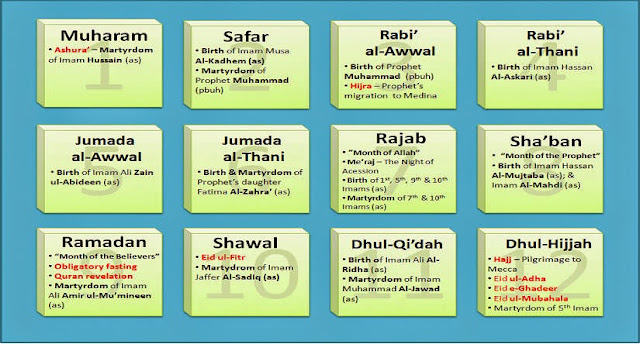
ISLAMIC ARABIC MONTHS IN ENGLISH

 The Islamic lunar calendar, was first introduced in 638 AD by the second Caliph (Khalifa in Arabic), `Umar ibn Al-Khattab. The starting point of the calendar however was set to about sixteen years earlier, to mark the Hijrah — i.e. the time of emigration of the prophet Muhammad from Mecca to Medina. The word hijrah means to leave a place to seek sancturary or freedom from persecution or freedom of religion (or any other purpose). The emigration to Medina was a historic event, as it marked the turning point from persecution to freedom and acceptance of Submission (Islam in Arabic). 
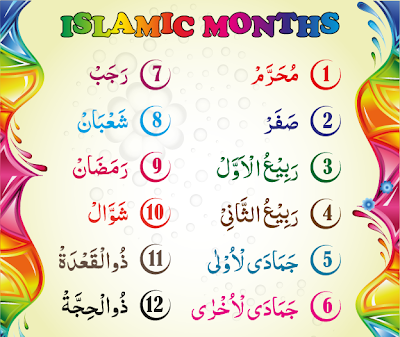
ISLAMIC ARABIC MONTHS IN ENGLISH

 The actual starting date for the Calendar was chosen to be the first day of the first month (1 Muharram) of the year of the Hijrah. The Islamic (Hijri) calendar is usually abbreviated A.H. in Western languages (similar to A.D. used to mark the Christian calendar). Muharram 1, 1 A.H. corresponds to July 16, 622 A.D.
  1. Muharram
  2. Safar
  3. Rabi-ul-Awwal
  4. Rabi-ul-Aakhir
  5. Jumada-al-Oolaa
  6. Jumada-al-Aakhirah
  7. Rajab
  8. Sha'ban
  9. Ramadhan or Ramzan
  10. Shawwal
  11. Zul-Qa'dah
  12. Zul-Hijjah
ISLAMIC ARABIC MONTHS IN ENGLISH

Largest Umbrella Installing Makkah al-Mukarramah

World’s largest umbrella being installed in Makkah Haram Soon

Largest Umbrella Installing Makkah al-MukarramahThe Work started on Thursday for the installation of the world’s largest folding umbrella in the northern courtyard of the Grand Mosque in Makkah.
This is the first of the eight high-tech giant umbrellas and 54 small ones to be installed in the Grand Mosque in the coming six months.   
Being manufactured in Germany, each canopy will consist of a giant clock, screens of guidelines for worshippers, air-conditioners , and surveillance cameras. Each umbrella will have a height of 45 meters and weigh 16 tons. It will give shade to an area of 2,400 square meters when open.
Some 25 engineers, specialist technicians, and safety experts from Germany will supervise the installation process and electronic operating mechanism. Another 54 small umbrellas will also be installed in the northern courtyard, covering a total area of 19,200 square meters. As part of the project, 122 benches for worshippers to take rest as well as service buildings will be built. The infrastructure work for the installation of canopies have already started.
The entire northern plaza stretching from King Fahd Expansion structure to the King Abdullah Expansion structure of the mosque will have canopies when the project is completed. The shaded area will have the capacity to accommodate around 400,000 worshippers.
The General Presidency for the Affairs of the Two Holy Mosques is supervising the project, in cooperation with specialists from the Ministry of Education and the contracting company, which is implementing the largest ever expansion of Islam’s holiest site.
In December 2014, a few weeks before his death, King Abdullah ordered the installation of umbrellas in the courtyards surrounding the Grand Mosque.

World’s largest umbrella in Grand Mosque Makkah

Sheikh Abdulrahman Al-Sudais, head of the presidency, announced then that the King’s order came to provide shading for external plazas, in addition to the areas approved in the King Abdullah Expansion project, with an additional area estimated at 275,000 square meters. More than 300 canopies will provide shade from the sun to the visitors of the Grand Mosque, he said.
Nearly 250 similar umbrellas have been installed on the plazas around the Prophet’s Mosque in Madinah earlier. Like blooming flowers, the umbrellas are programmed to fold and unfold in minutely delayed sequence to avoid collision between their moving parts. Their near-silent operation is automatically aligned with changes in the daily temperature. They open each morning, creating a translucent ceiling, and retract each evening in less than three minutes.
World’s largest umbrella in Grand Mosque Makkah
In summer, the open umbrellas provide daytime shade and reflect away much of the sun’s radiant energy. When closed at night, they allow residual heat absorbed by the stone floors and walls to escape back into the atmosphere. The process is reversed in winter. When temperatures are relatively low, umbrellas are closed during the day to allow the winter sun to warm the site, and opened at night to retain heat near ground level.

Source: www.saudigazette.com.sa

World’s largest umbrella being installed in Grand Mosque in Makkah

Related Posts Plugin for WordPress, Blogger...